


Entrepreneurship & Management: the ESE course that turns ideas into projects
Master entrepreneurship with ESE. Learn to build a startup, leverage AI, and master the pitch in our intensive course....
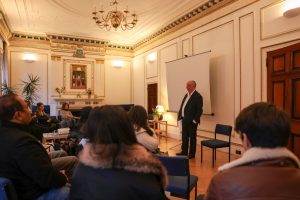
Read moreThe film industry is no longer just about lights, camera, and action—it is about algorithms, financing models, and logistical mastery. ESE London recently welcomed James F. Simpson, the acclaimed producer, director, and screenwriter behind The Merchant of Venice (BAFTA nominee) and The Bridge of San Luis Rey.
With a career spanning two decades and collaborations with legends like Al Pacino, Robert De Niro, and Charlize Theron, Simpson provided ESE students with an unfiltered masterclass on the realities of modern filmmaking.
For students pursuing our MBA in Film Industry Management or our specialised Short Course in Film Industry Management, this session was a perfect case study in how theory meets the rigorous demands of the global marketplace.
One of the core tenets taught at ESE is adaptability in business models. Simpson highlighted a seismic shift in the industry: the collapse of traditional revenue streams.
In the early 2000s, producers relied heavily on DVD sales and television rights. Today, the dominance of streaming giants like Netflix, Amazon, and Apple has revolutionized access but squeezed producer revenues. This shift forces today’s filmmakers to rethink financial modeling: a critical skill covered in the ESE MBA Film Industry programme. Simpson noted that while budgets are shrinking, the need for financial creativity is at an all-time high.
Simpson offered a fascinating comparison of production logistics then and now.
For students on our Film Industry Short Course, understanding this technological workflow is vital. High-quality visual effects are now accessible to smaller production teams, democratizing the ability to tell epic stories without a blockbuster budget.
Perhaps the most valuable lesson for aspiring producers was Simpson’s candid breakdown of film financing. He described the industry’s great paradox:
“You need major actors to attract investment,
but you need funding to secure the actors.”
To navigate this “chicken and egg” scenario, Simpson advised emerging filmmakers to leverage independent films and sales agents at major markets like Cannes, Venice, and Berlin. This strategic networking is exactly what ESE prepares students for, providing the industry awareness needed to build credibility before the cameras even roll.
Addressing the elephant in the room, Simpson discussed the rise of Artificial Intelligence in screenwriting and voice replication. While acknowledging AI’s role in improving efficiency, he drew a firm line in the sand regarding creativity.
Referencing Steven Spielberg’s views on the transformative power of music, Simpson argued that true originality stems from human insight, emotional intelligence, and lived experience; qualities that algorithms cannot replicate. For ESE students, this reinforces that while technical skills are essential, it is their unique artistic vision that will define their careers.

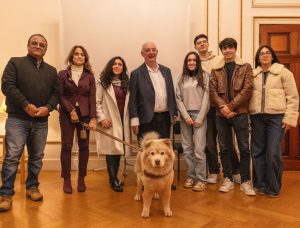
James F. Simpson’s visit exemplifies the ESE philosophy: Learning goes beyond the classroom.
Whether managing a crew of 70 people, handling on-set catering logistics for a $36 million drama, or navigating the ethics of AI, the modern filmmaker must be a hybrid of artist and entrepreneur.
At the European School of Economics, we do not educate spectators: we forge pragmatic dreamers, individuals capable of commanding the industry through inner vision and creative responsibility.
Our approach to Film Business springs from a higher law: the understanding that every transformation begins within.
As ESE Founder and President, Elio D’Anna reminds us:
“The abandonment of obsolete conceptions and narrow visions of the world, and their substitution with innovative ideas, would be impossible if a new vision did not first find its place in the heart and mind of individuals gifted with a more mature psychology — pragmatic dreamers, divers into the invisible, visionaries capable of conceiving and supporting ideas of such power and vastness as to be unbearable for all the others… Vision and reality are one and the same thing. When the vision changes, reality follows.”
Master entrepreneurship with ESE. Learn to build a startup, leverage AI, and master the pitch in our intensive course....
Read more
Master the art market with ESE’s Art Business courses in London. Explore Mayfair galleries and decode the alchemy...
Read more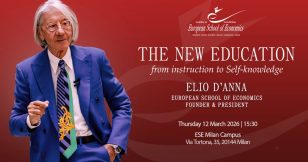
ESE Founder Elio D’Anna’s talk in Milan: a transformative vision of education focused on self-knowledge, purpose,...
Read more
Leonardo Bagnoli, President of Sammontana, visits ESE Florence to discuss family business, leadership, and love....
Read more